

news
Introducing the Quick-Start Portfolio: Self-Guided Experiential Learning with Built-in Assessments
Supply chain education is evolving fast. Across our conversations with educators and insights gathered through our recent Annual Trends in Education Survey, a consistent reality continues to emerge: educators are expected to keep pace with rapid industry change while simultaneously managing growing pressure around engagement, assessment, scalability, and workload.
Keeping course content aligned with industry practice, motivating students, managing assessment and grading workload, and integrating technologies such as AI are now among the most pressing challenges in modern supply chain education.
At the same time, experiential learning is becoming increasingly important. Universities want students to move beyond theory and develop practical decision-making skills that prepare them for the realities of modern supply chains. Yet implementing experiential learning at scale often remains difficult in practice.
Large student groups, limited preparation time, fully designed curricula, assessment complexity, and facilitation requirements can make it challenging to integrate simulation-based learning in a way that remains manageable and consistent.
These realities are exactly what inspired the development of the Quick-Start Portfolio.
Introducing the Quick-Start Portfolio
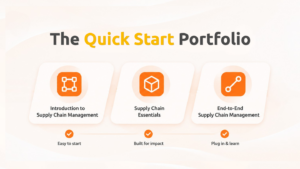
The Quick-Start Portfolio is a new set of self-guided, simulation-based learning experiences for higher education, designed to make experiential supply chain learning easier to adopt, easier to run, and easier to assess.
Built around flexibility, scalability, and minimal preparation, the portfolio allows educators to integrate experiential learning into existing courses without the complexity often associated with traditional simulation delivery.
Students progress independently through guided learning journeys supported by in-game videos, structured content, and built-in debriefs, while educators receive the teaching materials, onboarding support, and assessment structure needed to run the experience confidently.
The portfolio introduces three learning experiences, each designed for different course levels, durations, and team dynamics.
Introduction to Supply Chain Management
Introduction to Supply Chain Management is an introductory individual learning experience where students follow a structured supply chain traineeship while discovering how decisions across sales, operations, purchasing, and supply chain impact overall business performance.
Supply Chain Essentials
Supply Chain Essentials is an introductory-to-intermediate experience for teams of two, focused on inventory and capacity management while navigating operational trade-offs and alignment between supply chain and operations.
End-to-End Supply Chain Management
End-to-end Supply Chain Management is a self-guided version of our most widely used learning experience, where teams manage the full supply chain together while balancing cross-functional decisions and navigating realistic business trade-offs.
Together, these experiences provide institutions with a more flexible and scalable way to integrate experiential learning across different stages of the curriculum.
Built-In Assessment Designed for Modern Higher Education
One of the defining elements of the Quick-Start Portfolio is its integrated assessment approach.
Assessment continues to be one of the most time-consuming and operationally challenging parts of experiential learning, particularly in large cohorts where educators must balance fairness, consistency, academic integrity, and limited grading capacity.
At the same time, the rise of AI-generated submissions is accelerating the need for assessment approaches that evaluate more than theoretical recall alone. Increasingly, educators need ways to assess how students think, apply concepts, make decisions, and reflect on outcomes.
Each Quick-Start learning experience therefore includes ready-made assessment options aligned with learning objectives and course level. Depending on the experience, educators can choose from theory-based, case-based, simulation-based, and performance-focused assessments designed to support scalable and consistent grading.
The assessments are built to help educators:
- evaluate understanding, application, and decision-making
- maintain fairness and consistency across larger cohorts
- reduce time spent designing and managing assessments
- align experiential learning more closely with academic requirements
- support academic integrity through applied evaluation formats
Importantly, educators maintain full control over final grading decisions while benefiting from a more structured and ready-to-use assessment framework.
Built Around the Reality of Teaching
The Quick-Start Portfolio reflects a broader shift happening within higher education.
According to the findings from Inchainge’s Annual Trends in Education Report 2026, educators are increasingly looking not only for content, but for better teaching leverage: solutions that help create learning experiences that are engaging, practical, scalable, and manageable within the realities of modern teaching.
This shift is especially relevant in supply chain education, where the field itself continues to evolve rapidly around topics such as resilience, sustainability, digitization, and AI.
The Quick-Start Portfolio was developed with these changing realities in mind. Rather than requiring educators to redesign entire courses or manage facilitation-heavy simulation delivery, it offers a structured and reliable way to introduce practical learning experiences with reduced implementation complexity.
Supporting Different Teaching Approaches
While the Quick-Start Portfolio is designed to support scalable and low-preparation experiential learning, Inchainge’s existing portfolio of facilitated simulations continues to play an important role within higher education.
For educators looking to explore specific supply chain and sustainability topics in greater depth, facilitated learning experiences remain highly valuable. Through active facilitation, guided debriefing, and deeper classroom interaction, these simulations allow students to engage more extensively with complex decision-making, collaboration, and strategic trade-offs.
Some educators may choose self-guided experiences for introductory or large-scale courses, while using facilitated simulations in advanced courses where deeper reflection, interaction, and guided discussion are central to the learning experience.
Together, the Quick-Start Portfolio and Inchainge’s facilitated learning solutions provide educators with flexible options for a multi-year supply chain program that align with different course objectives, teaching styles, class sizes, and levels of learner support.
Expanding Access to Experiential Supply Chain Learning
Over the past 15 years, Inchainge has supported universities worldwide with simulation-based learning experiences designed to connect education with real-world supply chain practice. Today, educators across more than 700 universities use Inchainge learning solutions to help students develop practical business and supply chain capabilities through experiential learning.
The Quick-Start Portfolio builds on that foundation while responding to the changing needs of higher education today: helping institutions deliver experiential learning that is easier to scale, easier to manage, and easier to integrate into existing programs.
As supply chain education continues to evolve, the challenge is no longer only what students should learn, but how universities can deliver meaningful learning experiences in ways that remain practical, engaging, and sustainable for educators themselves.
With the introduction of the Quick-Start Portfolio, Inchainge aims to help make that possible.