

New

Summative Assessment for Experiential Learning.

Evaluate how students think, apply knowledge, make decisions, and perform using flexible assessment options designed for experiential learning.

Ready-to-use assessment templates

Fully customizable by educators

Compatible with major LMS platforms

Book Assessment Consultation
Explore Assessment Portfolio
The Assessment Challenge

Assessing experiential learning isn't easy

Today's educators are expected to evaluate far more than theoretical knowledge.

Students need to demonstrate how they analyse situations, make decisions, and apply concepts in realistic business environments. At the same time, educators must assess those skills fairly, consistently, and efficiently across increasingly large cohorts.

The Inchainge Assessment Portfolio helps educators design and deliver authentic summative assessments without increasing complexity.

Summative Assessment Portfolio

Choose the assessment approach that fits your course.

Our assessment portfolio is designed to match the depth of learning you want to measure
(based on Bloom's Taxonomy) and the time you can allocate.

Introduction to Supply Chain Management

Assessment Format Bloom’s Levels Duration
Foundation
Theory-based
Remember, Understand 45–60 min
Applied
Case-based
Remember, Understand, Apply ~65 min

Supply Chain Essentials

Assessment Format Bloom’s Levels Duration
Applied
Case-based
Remember, Understand, Apply ~65 min

End-to-End Supply Chain Management

Assessment Format Bloom’s Levels Duration
Applied
Case-based
Understand, Apply, Evaluate ~80 min
Performance
Simulation-based
Analyze, Create ~90 min
Integrated
Case-based
Understand, Apply, Analyze, Evaluate, Create 90–120 min
Comprehensive
Case / Simulation
Understand, Apply, Analyze, Evaluate, Create 90–120 min
Bloom's Taxonomy

Assess learning at the right level of complexity.

Bloom’s Taxonomy is a widely used educational framework that categorizes learning into 6 different levels of cognitive complexity. It helps educators define what students should be able to know, apply, analyze, evaluate, and create throughout a course.

Experiential learning naturally supports applied learning. But not every course requires the same depth of assessment.

Our assessment portfolio helps educators choose the level of learning they want to assess, aligning assessment depth with course objectives, academic level, and available instructional time.

BLOOM’S TAXONOMY IN EXPERIENTIAL LEARNING

01

Remember

Recall facts, terms, concepts, and definitions.

02

Understand

Explain concepts and interpret business information.

03

Apply

Use knowledge in realistic business scenarios.

04

Analyze

Evaluate trade-offs, data, and operational performance.

05

Evaluate

Justify decisions and assess strategic impact.

06

Create

Develop strategies and improve business outcomes.

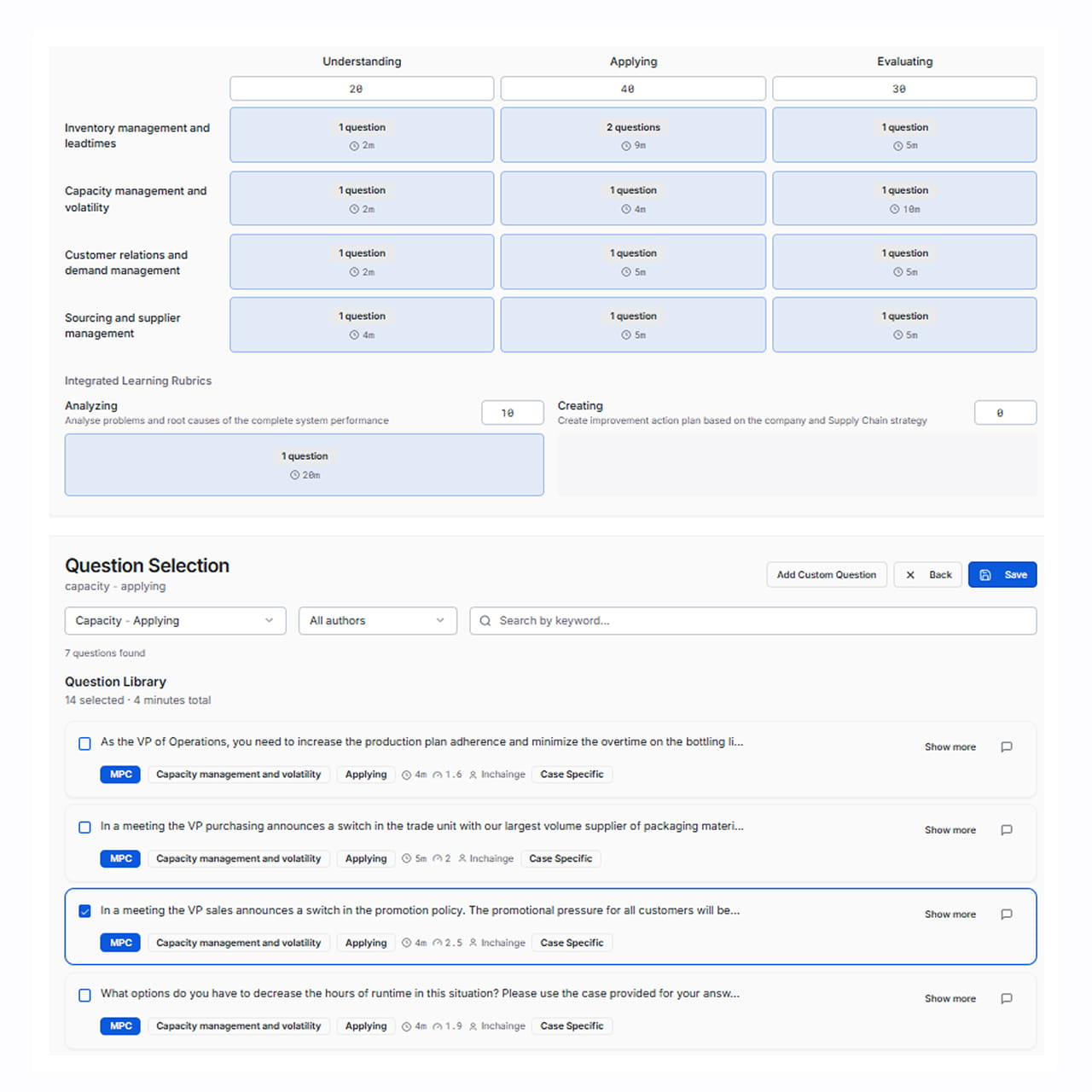
Assessment Design Tool

Design high-quality assessments in minutes

No need to build assessments from scratch. Create assessments aligned with your course objectives using ready-made templates, structured rubrics, and fully customizable questions.

The Assessment Design Tool enables educators to:

  • Start from proven assessment templates
  • Modify existing questions
  • Add their own questions
  • Align assessments with learning outcomes
  • Apply structured grading rubrics
  • Export assessments to LMS platforms such as, Canvas, Blackboard, Moodle, Brightspace, ANS

The Assessment Design Tool supports assessment design. Educators remain fully in control of delivery and grading.

FAQ

Frequently Asked Questions

What types of assessment formats are included in the portfolio?
Which learning solutions support the assessment portfolio?

The assessment portfolio is currently available for selected Inchainge learning solutions, including Introduction to Supply Chain Management, Supply Chain Essentials and End-to-End Supply Chain Management powered by The Fresh Connection.

Is the portfolio suitable for both Bachelor and Master-level education?
How does Bloom’s Taxonomy relate to the assessment portfolio?
Can the assessments be used in online or hybrid learning environments?
Do educators remain in control of grading and evaluation?
Can the portfolio support large student cohorts?

Ready to explore the right assessment approach for your course?

Request a discovery call and explore the assessment portfolio in more detail.