

blogs
Teaching Supply Chains When AI Knows the Answers
How can educators develop critical thinking, teach responsible AI use, and assess what students actually understand? Insights from three supply chain educators point toward a more deliberate approach to learning design.
A well-written report once gave educators a useful window into a student’s understanding. With generative AI, that window has become harder to see through.
Students can produce an analysis, compare suppliers, or generate recommendations in seconds. The work may look convincing. What remains less visible is whether they understand the assumptions, recognize the trade-offs, and can explain why a recommendation makes sense.
For supply chain educators, this challenge reaches beyond academic integrity. Students are preparing for careers in which AI will be available. They need opportunities to learn how to use it while developing the knowledge and judgment to question it.
That was the focus of Teaching Supply Chains When AI Knows the Answers, an Inchainge Connect Educator Series panel discussion hosted by Egge Haak with educators Marc Cashin, Deodat Mwesiumo, and Janaina Siegler.
Their experiences suggest a demanding but practical direction: design learning around the decisions students make, the reasoning they can explain, and the responsibility they retain when working with AI.

Widespread AI use does not mean students know how to learn with it
The Digital Education Council’s AI in Higher Education Global Survey 2026, discussed during the session, captures an important tension.
Among respondents, 88% of students use AI in their learning. Yet 66% worry that it could make learning too shallow and discourage critical thinking and creativity. Meanwhile, 73% of faculty believe students’ AI use may undermine their skills development.
These are reported concerns, rather than proof of a particular learning outcome. They nevertheless challenge the assumption that adoption automatically translates into educational value.
Jane described making a similar discovery in her teaching: “Don’t start from the assumption that students know how to use AI. Most of them don’t.”
Some students lack training; others hesitate because they are afraid to use it. Educators therefore need to demonstrate how to ask useful questions, evaluate a response, and connect the output to disciplinary knowledge.
Allowing AI in an assignment is only the beginning. Students need to learn what thoughtful use looks like.
Supply chain knowledge becomes essential to evaluating AI
If AI can perform calculations and propose solutions, why should students still learn the underlying models?
Because evaluating a recommendation requires knowing what to look for.
Deodat illustrated this through supplier selection. If AI helps students evaluate 20 suppliers, he still expects them to understand the mathematics well enough to evaluate a smaller selection themselves.
As he explained: “Working with AI does not exempt you from learning theories, frameworks, models.”
That principle extends beyond checking a calculation. Supply chain decisions interact across functions, and a recommendation that looks attractive locally may create problems elsewhere.
Marc described helping students understand the supply chain as a connected system: a procurement saving can affect quality, which can affect production. Jane similarly emphasized the relationships between inventory, purchasing, supplier location, and customer promises.
Students need that understanding to recognize what an AI-generated recommendation overlooks.
For educators, this makes the relationship between fundamentals and application particularly important. Students must be able to explain both how a method works and what its use means for the wider business.
Give students responsibility before and after the AI analysis
To structure this relationship, Egge introduced the “sandwich model,” which he credited to Tom van Woensel.
The model places AI-supported analysis between two stages of human judgment.
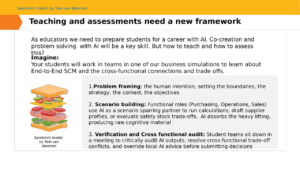
Frame the problem
Students establish the context, objectives, boundaries, and strategic priorities.
In a team-based supply chain simulation, this means agreeing on what the team is trying to achieve before asking AI for recommendations. What matters most? Which constraints apply? What trade-offs are acceptable?
Problem framing is itself a skill that needs to be taught and assessed.
Use AI to explore scenarios
Students then use AI as a sparring partner: running calculations, exploring options, and examining questions from different functional perspectives.
The technology supports the analytical workload. Students still need to understand the concepts behind the analysis.
Verify the output and make the decision
Students critically examine the recommendations, resolve conflicts across functions, and decide whether to accept, adapt, or override the advice.
This stage requires more than checking whether an answer sounds plausible. It asks whether the recommendation fits the strategy and works across the supply chain.
Marc added an explicit role for reflection after each activity or simulation round. Students should explain what they learned from the process and how that learning informs their next decisions.
Together, these practices give AI a defined contribution while keeping students accountable for their choices.
A framework only works if educators can see students thinking
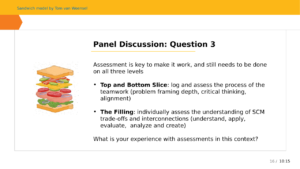
Deodat identified a significant weakness in any apparently clear division between human and AI work: students can use AI for every stage.
They can ask one tool to frame the problem, another to analyze it, and another to evaluate the result. A submission may follow the required structure without revealing much student understanding.
His warning was memorable: educators may believe they are serving a sandwich, while actually serving mashed potato, with everything mixed together.
The implication is practical. Asking students to “evaluate critically” is insufficient unless the learning design gives educators evidence of that evaluation.
Deodat described moving around the classroom as teams work, listening to how students discuss the task, challenge one another, and critique AI output. His role has shifted toward organizing and facilitating the learning experience.
This requires involvement. The panel’s examples do not suggest that introducing AI automatically reduces the educator’s workload. They show how teaching changes when more attention goes toward observing, questioning, and guiding students’ reasoning.
Compare manual reasoning with AI-supported analysis
Deodat described giving students a task involving substantial data and limited time. Students first work manually, then use AI, and compare the approaches.
The activity creates a basis for discussion: how did they approach the problem, what did AI contribute, and how should they evaluate the output?
Because the educator observes the work, the learning process becomes part of the classroom conversation.
Stress-test AI against evidence and theory
Jane described a current-events assignment in which students find and read a recent article from a credible publication and connect it to the supply chain topic being taught.
They then use AI to explore additional perspectives and analyze the issue. Their task is to stress-test the analysis: where is it right, where is it wrong, and what has it missed?
Students subsequently present and defend their argument.
The assignment brings together independent reading, disciplinary knowledge, AI use, and verbal explanation. Follow-up questions (why, how, and on what evidence) help reveal whether students understand the argument they present.
Both examples create a reason for students to examine AI output closely. Producing an answer becomes one stage in a larger learning process.
Assess both the process and individual understanding
A recurring message throughout the discussion was that one assessment format cannot capture everything educators need to know.
The panel described several complementary sources of evidence:
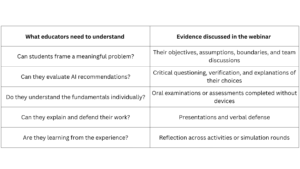
Marc emphasized making AI use visible through disclosure and reflection. This gives educators an opportunity to examine how the technology contributed to the work.
Deodat also described reviewing students’ conversations with an AI tutor. Their questions and prompts help him identify misunderstandings and address them in subsequent sessions.
Such records can support formative feedback, but they require interpretation. A prompt history alone cannot establish everything a student understands.
Assessment also influences behavior. If educators want students to challenge recommendations, apply theory, and reflect honestly, those activities need a meaningful place in the assessment.
Teach capabilities that transfer across tools and learning environments
Audience questions brought two further issues into focus: unequal access to AI tools and the application of these approaches online.
Marc and Deodat both argued against building teaching around mastery of every platform. Tools change quickly. Problem framing, disciplinary understanding, output evaluation, and decision-making offer a more durable foundation.
Access still matters. Deodat described using a shared, customized learning environment so students could access the same tools.
The online discussion also showed that implementation depends on the learners and course objectives. Deodat described online oral examinations for experienced learners, while Jane explained how assessments could remain aligned across online and in-person formats.
The useful design question is what evidence will demonstrate the intended learning in each setting.
The challenge educators still need to solve: scale
The discussion offered practical approaches, but it also acknowledged an unresolved problem.
Observing team discussions, reviewing AI interactions, and conducting verbal assessments take time. Egge explicitly raised the challenge of assessing problem framing, teamwork, and reflection in a scalable way.
That limitation matters when translating an individual educator’s practice into a larger course or program.
A manageable starting point is one assignment. Define what students must understand independently, where AI can contribute, and how students will demonstrate their own reasoning. Then consider which evidence the educator can realistically review and use.
Make student thinking the center of AI-supported learning
AI makes it easier to produce an answer. Supply chain education must help students develop the judgment to decide whether that answer deserves to become a business decision.
That requires disciplinary knowledge, an understanding of connections across functions, and the confidence to challenge a convincing recommendation. It also requires learning experiences and assessments that make those capabilities visible.
The educators in this discussion approached that task through problem framing, explicit guidance on AI use, reflection, and individual checks of understanding. Their examples offer a clear direction: give students opportunities to work with AI while requiring them to explain, evaluate, and take responsibility for their decisions.
For educators, the next step can start with one question: What evidence will show that my students understand the decisions they are making?
Bring these principles into your classroom
Inchainge’s game-based learning solutions give students opportunities to navigate supply chain trade-offs and experience the consequences of their decisions. Assessment tools and AI-supported learning features can help educators build on that experience.
Explore how our assessment tools can support individual checks of understanding, and how features such as the AI Tutor and AI Dynamic Debriefs can support students during learning and reflection. Explore our portfolio summative assessments and AI tools
Want to hear how fellow educators approach these challenges? Fill in the contact form below to receive full webinar recording for classroom examples and perspectives on teaching and assessment or download the webinar slides (PDF)